MOE Secondary Chinese Syllabus Explained: What Parents Must Know
Understanding the MOE Chinese syllabus is essential for parents who want to support their child’s progress at the secondary level. As students move from primary to secondary school, the syllabus becomes more demanding, with greater emphasis on comprehension, writing accuracy, oral communication, and application skills.
For many families, Secondary Chinese Tuition Singapore plays a vital role in helping students adapt to these increasing expectations while staying aligned with MOE requirements.

Overview of the MOE Secondary Chinese Syllabus
The MOE Secondary Chinese syllabus is designed to develop students who can use Chinese confidently, accurately, and meaningfully in academic and real-life contexts. It focuses not only on language knowledge, but also on critical thinking and cultural appreciation.
Students are assessed across multiple components, including reading comprehension, writing, listening, and oral communication. Each component builds progressively from Secondary 1 to Secondary 4 or 5, requiring consistent practice and structured learning.

Key Components Parents Should Understand
The syllabus is structured to assess a student’s overall language competency rather than rote memorisation. Each component carries weight in school-based and national examinations.
Reading Comprehension
Students are tested on their ability to understand passages, infer meaning, and answer both direct and higher-order questions. Vocabulary depth and sentence analysis play a major role here.
Writing (Composition & Situational Writing)
Writing tasks require students to apply grammar, vocabulary, and structure accurately. Marks are awarded for content relevance, language accuracy, and organisation of ideas.
Listening Comprehension
This component assesses how well students understand spoken Mandarin in different contexts. It requires familiarity with various accents, tones, and speaking speeds.
Oral Communication
Oral exams evaluate pronunciation, fluency, clarity of ideas, and interaction skills. Students must respond confidently and express opinions clearly.
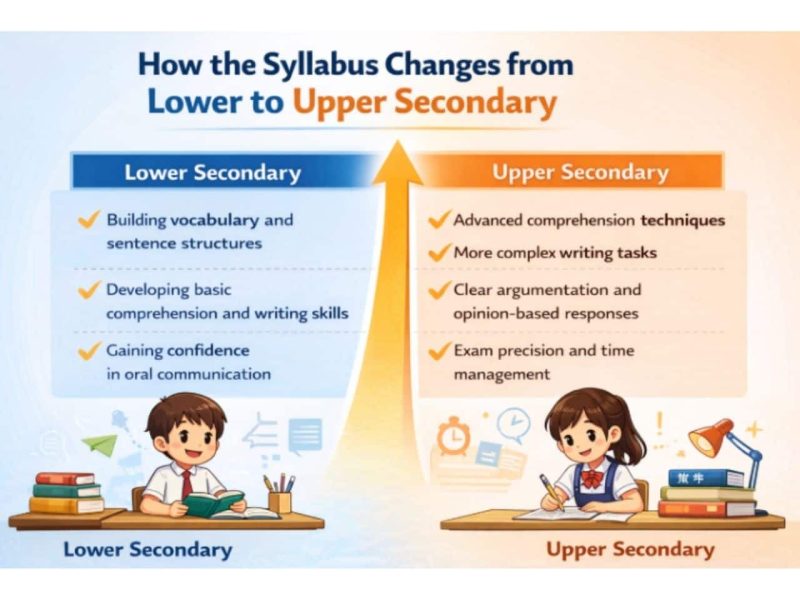
How the Syllabus Changes from Lower to Upper Secondary
One challenge parents often overlook is how quickly the syllabus intensifies after Secondary 2. The shift is not only in difficulty but also in expectations.
Common Challenges Students Face Under the MOE Chinese Syllabus
Despite regular school lessons, many students struggle to keep up due to the syllabus pace and exam demands. Common challenges include limited vocabulary retention, weak sentence construction, and lack of confidence in oral exams.
Another major issue is the application. Students may recognise grammar rules but fail to apply them correctly under exam conditions. Without targeted guidance, gaps can widen over time.
This is why many parents turn to Secondary Chinese Tuition Singapore to provide structured reinforcement and exam-focused practice aligned with MOE standards.
How Secondary Chinese Tuition Supports MOE Syllabus Learning
Effective tuition complements school teaching rather than replacing it. It focuses on reinforcing weak areas while preparing students strategically for assessments.
Key benefits include:
1.) Focused practice on MOE-style questions
2.) Guided writing with clear feedback
3.) Targeted oral and listening drills
4.) Consistent revision aligned with school timelines
With smaller class sizes or personalised instruction, students gain the confidence and clarity needed to meet syllabus expectations
Sec 1 Chinese Lesson: How to Write a Formal Email
Formal email writing is a key skill introduced at Secondary 1 under the MOE Chinese syllabus. It forms part of situational writing and tests a student’s ability to communicate clearly, politely, and accurately. Mastering this early helps students perform better in both school assessments and national exams.
1.) Understand the correct structure of a formal email
2.) Learn appropriate greetings and respectful closings
3.) Write clearly with a formal and suitable tone
4.) Present purpose and key details logically
5.) Apply accurate grammar and relevant vocabulary
6.) Practise common exam-based scenarios
7.) Build confidence for upper secondary writing tasks
What Parents Can Do to Support Learning at Home
Parents do not need to be fluent in Chinese to support their child. Simple actions can make a meaningful difference.
Helpful steps include:
1.) Encouraging regular reading of Chinese materials
2.) Discussing school feedback and exam results
3.) Ensuring consistent revision instead of last-minute study
4.) Supporting structured tuition when needed
When parents understand the syllabus, they are better equipped to guide their child effectively.
Final Takeaway
The MOE Secondary Chinese syllabus is comprehensive and demanding, requiring consistent effort and proper guidance. By understanding its structure, expectations, and progression, parents can make informed decisions to support their child’s learning journey.
For students who need additional reinforcement, Secondary Chinese Tuition Singapore at Unitimes Academy provides focused support that aligns closely with MOE requirements, helping learners build confidence, accuracy, and exam readiness.
Frequently Asked Questions
Is the MOE Secondary Chinese syllabus the same for all schools in Singapore?
The core syllabus is standardised by MOE, but schools may differ in pacing, teaching methods, and internal assessments. This is why some students may need additional reinforcement outside school.
When should parents consider Secondary Chinese Tuition Singapore for their child?
Parents should consider tuition when students show difficulty in comprehension, writing accuracy, oral confidence, or exam performance, especially during key transition years like Secondary 2 and Secondary 3.
How does tuition align with MOE examination requirements?
Quality tuition programmes follow MOE syllabus guidelines closely, using exam-style questions, structured practice, and targeted feedback to help students meet national assessment standards confidently.
 Ms Liu